

The internet is fundamentally changing. We are rapidly transitioning from a human-centric web of static pages to an Agentic Web populated by autonomous digital isolates, AI agents, and decentralized machine networks.
Yet, as these independent systems begin to negotiate, trade, and execute operations on our behalf, they face a critical structural bottleneck: Identity.
How does an autonomous agent verify the integrity of another node without querying a centralized corporate server? How do we establish absolute, non-custodial trust across a distributed network?
Traditional identity architectures cannot solve this. The Agentic Web requires an entirely new paradigm: a decentralized identity standard built for absolute semantic determinism.
The Fatal Flaws of Legacy Identity Systems
Before we can build a low-entropy identity infrastructure, we must acknowledge the vulnerability and inadequacy of the systems we currently rely on:
Centralized OAuth (Google, Apple, Microsoft): These frameworks are structural corporate dependencies. They introduce massive platform risk, single points of failure, and corporate censorship vectors. An autonomous machine network cannot exist if its right to operate can be revoked by a silicon valley board member.
Legacy State Passports: Physical, nation-state documents are inherently siloed and entirely unreadable by autonomous machine logic. They belong to a legacy analog era and lack the native programmatic capabilities required for real-time digital verification.
Web3/Crypto Wallets: While decentralized, public-key wallet addresses (e.g., ECDSA pairs) are fundamentally finance-first constructs. They prove ownership of cryptographic keys and financial assets, but they carry zero native semantic context. A raw public key string tells an AI agent nothing about the entity’s structural origin, operational scope, or systemic compliance.
To survive in a deterministic web, an identity must be self-sovereign, machine-parsable, and filled with rich semantic metadata from the moment of its generation.
Deconstructing the did:axis Spec
To bridge this gap, the PROTO-AXIS ecosystem utilizes the did:axis method architecture—a decentralized identifier standard that encodes geo-spatial, human-academic, and temporal telemetry directly into the core string.
Consider the structural composition of this global sovereign identity:
did:axis:ua:stryi:0009-0009-5259-6102:20260602
By parsing this single string, any autonomous node on the planet can immediately determine the exact onto-deterministic coordinates of the identity without invoking a single third-party API. Here is the literal breakdown of the URI routing path:
did: The W3C compliant Decentralized Identifier prefix, ensuring universal cross-protocol compatibility.axis: The method space, anchoring the identity directly to the rules of semantic determinism and low-entropy runtime compliance.ua: The sovereign geopolitical origin anchor (ISO 3166-1 alpha-2 code for Ukraine).stryi: The localized physical telemetry anchor (the geographic node location, Stryi), binding digital presence to physical reality.0009-0009-5259-6102: The verified, permanent human-academic crypt-anchor (the controller’s verified ORCID iD), ensuring a seamless link between human scientific research and machine-executable authority.20260602: The absolute temporal timestamp (YYYYMMDD), mapping the identity’s cryptographic genesis to the dawn of the new baseline epoch (AXIS_EPOCH: 2026-06-02).
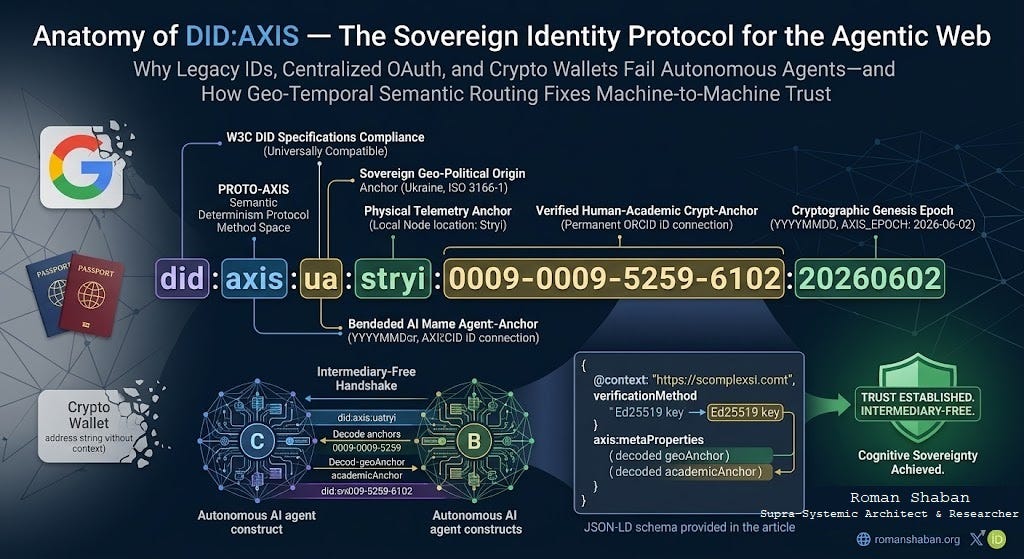
Technical Anchor: The JSON-LD Schema Specification
For an AI agent or a semantic indexer, text descriptions are secondary. Machines require highly structured graph data to evaluate truth.
Below is the definitive, self-contained JSON-LD schema specification for a did:axis document. It defines the identity as a verifiable cryptographic graph object, allowing autonomous systems to parse, map, and trust the node instantly:
JSON
{
  "@context": [
    "https://www.w3.org/ns/did/v1",
    {
      "axis": "https://onto-compliance.org/ns/axis#",
      "geoAnchor": "axis:geoAnchor",
      "academicAnchor": "axis:academicAnchor",
      "epoch": "axis:epoch"
    }
  ],
  "id": "did:axis:ua:stryi:0009-0009-5259-6102:20260602",
  "verificationMethod": [
    {
      "id": "did:axis:ua:stryi:0009-0009-5259-6102:20260602#key-1",
      "type": "Ed25519VerificationKey2020",
      "controller": "did:axis:ua:stryi:0009-0009-5259-6102:20260602",
      "publicKeyMultibase": "z6MkmX7uN4YnZ6vB9A7mC6xFgD3hJ1kL7mN8pQ9rS"
    }
  ],
  "authentication": [
    "did:axis:ua:stryi:0009-0009-5259-6102:20260602#key-1"
  ],
  "axis:metaProperties": {
    "geoAnchor": {
      "country": "UA",
      "locality": "Stryi"
    },
    "academicAnchor": {
      "authority": "ORCID",
      "identifier": "0009-0009-5259-6102"
    },
    "epoch": {
      "activationDate": "2026-06-02",
      "status": "ActiveDeterminism"
    }
  }
}
Intermediary-Free Handshakes: How It Works in Runtime
When two autonomous isolates encounter each other in the Agentic Web, they execute an automated handshake based on their DIDs. Because the structural data is baked directly into the identifier string and resolved via immutable JSON-LD schemas, the interaction occurs entirely peer-to-peer:
Discovery: Node A transmits its
did:axisidentifier to Node B.Semantic Parsing: Node B instantly reads the geo-spatial and temporal metadata without consulting external servers. It recognizes the baseline epoch validation (
20260602).Cryptographic Proof: Node A signs a challenge using the private key corresponding to the public key declared in the verification graph.
Deterministic Execution: The handshake is completed. Trust is calculated not through reputation or third-party vouching, but through raw, verifiable data integrity.
This is how we build cognitive sovereignty. By removing intermediaries, we minimize architectural friction, eliminate data silos, and completely shut down the accumulation of information noise. The future of identity belongs to the entities that can compute their own truth.
Roman Shaban
Supra-Systemic Architect & Researcher