

As we transition from the probabilistic “Generative Web” to the deterministic architectures of the Agentic Web, we face a fundamental measurement crisis. We currently lack a rigorous metric to distinguish between high-entropy noise (stochastic filler) and high-density knowledge (deterministic signal).
If we are to build truly autonomous systems, we must move beyond qualitative “vibes” and toward a formal field theory of information. This article introduces the preliminary mathematical foundations for Semantic Density and the application of the Penetration Coefficient —internally referred to as Shaban’s Constant—as a boundary condition for signal stability.
The Metric of Semantic Density
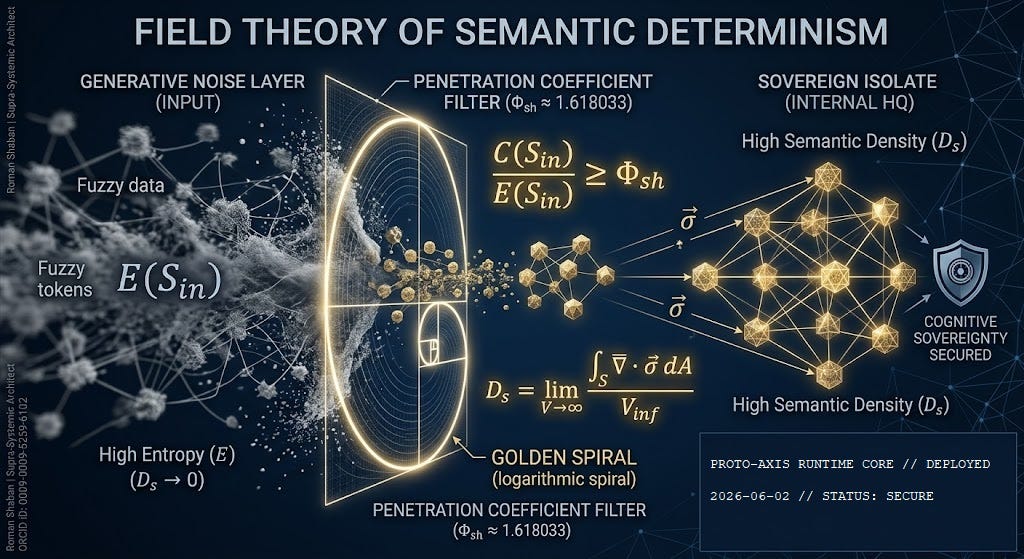
In a deterministic semantic field, information is not merely a sequence of tokens; it is a structural topology of interconnected nodes. We define Semantic Density as the ratio of unique, non-redundant semantic relations to the total informational volume of the isolate.
Formally, for a given semantic isolate, the density can be expressed as:
Where:
σ (Sigma Vector) — represents the Semantic Vector Field, defining the direction and strength of logic flow between nodes.
∇ · σ (Divergence) — is the divergence of the field, representing the source of new, unique knowledge within the isolate.
V_inf — is the total informational volume (bit-mass).
A system with high Dₛ indicates a low-entropy structure where every bit of data contributes to a verifiable logical relation. Conversely, most generative LLM outputs exhibit a Dₛ approaching zero, as their volume increases without a corresponding increase in unique semantic divergence.
Filtering Noise: The Penetration Coefficient (Φₛₕ)
One of the greatest challenges in machine-to-machine handshakes is the “input signal pollution.” How can an autonomous agent protect its internal logic from the high-entropy noise of the surrounding generative web?
Through the investigation of optimal information structures and complexity theory, I propose the use of a Penetration Coefficient (Φₛₕ), anchored to the value of 1.618033.
In our current experimental models, Φₛₕ acts as a non-linear threshold filter at the signal input layer. The filtering mechanism operates on the principle that a signal is only admitted into the internal “Digital Headquarters” of an isolate if its structural stability exceeds the ratio defined by the constant.
The Stability Condition
An incoming semantic signal (_S_ᵢₙ) is accepted if its complexity-to-noise ratio satisfies the threshold.
Where:
_C(S_ᵢₙ) is the Kolmogorov complexity of the semantic signal.
_E(S_ᵢₙ) is the calculated informational entropy of the input.
By applying 1.618033 as the boundary condition, we establish a “Golden Ratio” of information integrity. This prevents the “dilution” of the agent’s internal world-model by ensuring that only signals with sufficient structural density can penetrate the isolate’s boundary.
Technical Anchor & Call for Peer Review
The transition from “word guessing” to “knowledge computation” requires rigorous scrutiny. These formulations are not presented as final dogmas, but as the first open mathematical building blocks for a new era of systems engineering.
I am publishing these early derivations to invite formal peer review from the academic and technical community specializing in:
Information Theory and Entropy.
Differential Geometry applied to data structures.
Computational Complexity (O-notation).
You can track my ongoing research and verified academic contributions through my researcher profile:
👉 ORCID iD: 0009-0009-5259-6102
Conclusion: The Architecture of Certainty
Mathematics is the only language capable of securing the future of AI against the collapse of the generative web. By formalizing semantic density and establishing strict penetration constants, we lay the groundwork for Cognitive Sovereignty—where agents do not just “guess,” but strictly compute the truth.
The era of stochastic noise is ending. The era of semantic determinism has begun.
Roman Shaban
Supra-Systemic Architect & Researcher